


A child throws materials during math instruction. Another child does the exact same thing during reading time. The behavior looks identical, but one child is escaping a task they find overwhelming while the other is seeking attention from the teacher. A functional behavior assessment is how you tell the difference, and getting it right determines whether your intervention actually works.
The functional behavior assessment (FBA) is one of the most critical competencies in applied behavior analysis. It is the systematic process that transforms guesswork into evidence-based treatment. The BACB Ethics Code for Behavior Analysts requires a functional assessment before implementing any behavior-reduction procedures. This is not optional; it is an ethical mandate for every BCBA and BCaBA.
This guide covers the complete FBA process from start to finish, written specifically for ABA practitioners. Whether you are a BCBA conducting assessments independently or an RBT collecting data under supervision, you will find actionable guidance for every stage of the process.
What Is a Functional Behavior Assessment?
A functional behavior assessment is a systematic, evidence-based process used to identify the environmental variables that maintain problem behavior. Rather than simply describing what a person does, an FBA answers the more important question: why do they do it?
The core principle underlying every FBA is that all behavior serves a function. Challenging behavior is not random; it communicates something about the individual's environment, needs, or skills. The job of the behavior analyst is to decode that communication through careful assessment.
The Four Functions of Behavior
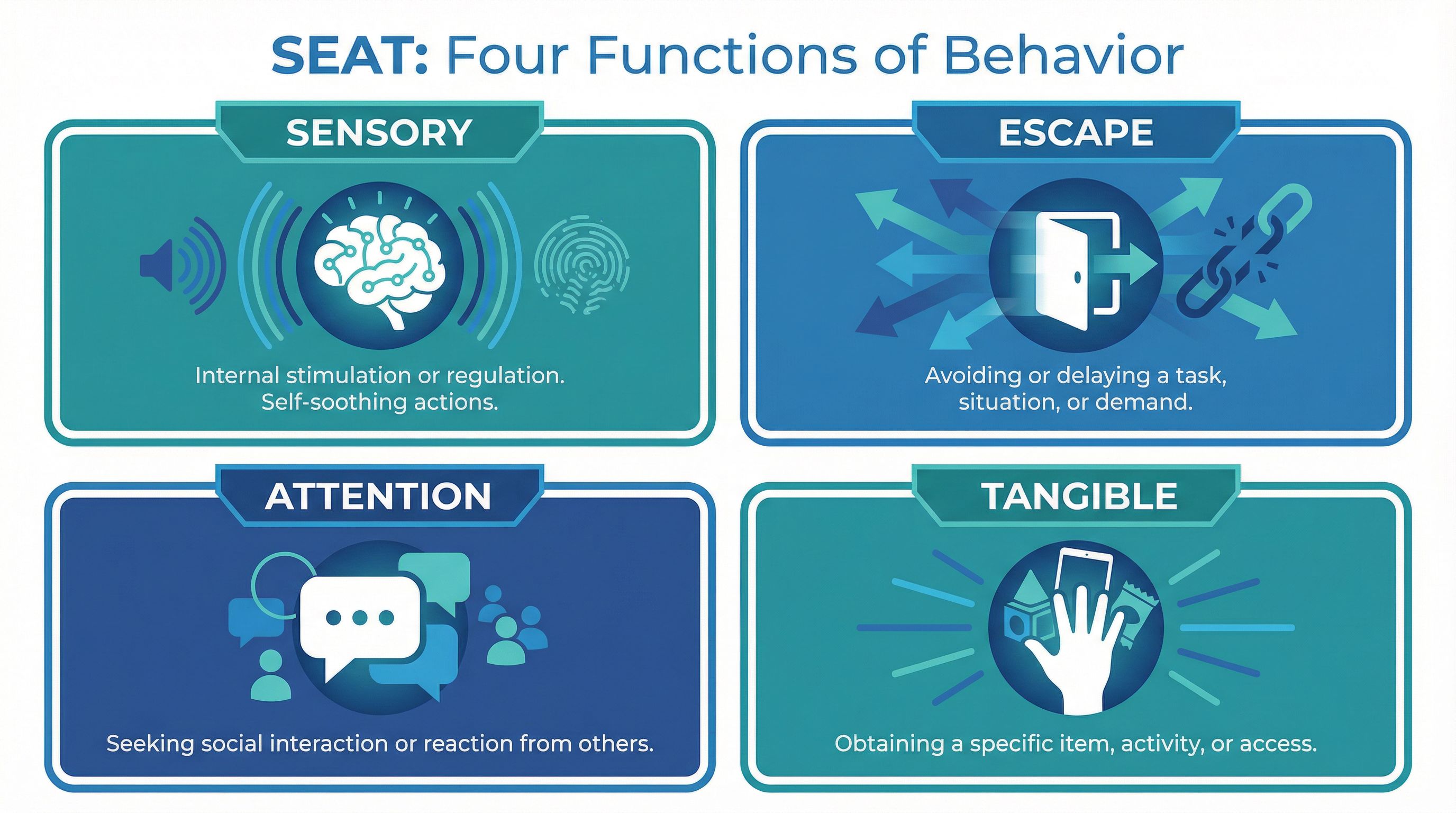
Research consistently identifies four primary functions of behavior, often remembered using the SEAT mnemonic:
- S Sensory/Automatic: The behavior produces its own reinforcement through internal sensory consequences, without requiring social mediation. A child rocks back and forth because the vestibular input is inherently reinforcing.
- E Escape: The behavior functions to remove or avoid an aversive stimulus, task, or demand. A student crumples their worksheet to end a difficult assignment.
- A Attention: The behavior produces social interaction, whether positive (praise, conversation) or negative (reprimands, redirections). A child calls out during class because any response from the teacher reinforces the behavior.
- T Tangible: The behavior functions to obtain preferred items, activities, or privileges. A child grabs a toy from a peer because it produces access to that item.
In the foundational study by Iwata and colleagues analyzing 152 participants, escape accounted for 38% of self-injurious behaviors, followed by positive reinforcement at 26.3%, automatic reinforcement at 25%, and multiple or unclear functions at 10.9%. These proportions highlight why assuming a behavior's function without assessment leads to ineffective interventions.
FBA vs. Functional Analysis: Key Differences
These two terms are frequently confused, but they describe different levels of assessment rigor.
A functional behavior assessment is the umbrella term for the entire assessment process. It includes indirect methods (interviews, rating scales), descriptive methods (ABC observation), and sometimes experimental methods. An FBA typically takes place in natural environments like the home, school, or clinic.
A functional analysis (FA) is a specific experimental procedure within the broader FBA process. It involves systematically manipulating antecedent and consequent variables in controlled conditions to verify the function of behavior. The standard functional analysis, developed by Iwata and colleagues in 1982, uses test and control conditions to isolate specific maintaining variables.
A 2024 comparative effectiveness trial published in the Journal of Applied Behavior Analysis found that all 48 treatment completers achieved 90% or greater behavior reduction regardless of whether they received a full functional analysis or descriptive assessment alone. The functional analysis required approximately 22 additional sessions without improving treatment outcomes (Slaton, Hanley, et al., 2024). This does not mean functional analysis is unnecessary; it remains the gold standard when precision is critical, behavior is severe, or descriptive results are ambiguous. However, practitioners should know that well-conducted descriptive assessments can produce effective interventions in many clinical situations.
Three Types of Functional Assessment Methods
Understanding when to use each assessment method is essential for efficient, effective practice.
Indirect Methods
Indirect methods gather information from people who know the individual well, without requiring direct observation. Common tools include:
- Motivation Assessment Scale (MAS): A 16-item rating scale that helps identify the most likely function of behavior based on caregiver report
- Functional Assessment Screening Tool (FAST): A brief screening questionnaire for initial function identification
- Questions About Behavioral Function (QABF): A 25-item instrument covering all four behavioral functions with demonstrated reliability
- Structured interviews: Open-ended conversations with caregivers, teachers, and other stakeholders about antecedents, consequences, and setting events
Indirect methods are fast and cost-effective for initial screening, but they rely on others' perceptions and memory, which can introduce bias. They should never be the sole basis for treatment planning.
Descriptive/Direct Methods
Direct methods involve observing the behavior in its natural setting and recording data in real time:
- ABC (Antecedent-Behavior-Consequence) recording: The most common method. Document what happens immediately before, during, and after the target behavior
- Scatterplot analysis: Track when behavior occurs across time intervals to identify temporal patterns (time of day, day of week, specific activities)
- Structured Descriptive Assessment (SDA): A standardized observation protocol that combines the strengths of ABC recording with more systematic data collection procedures
Direct methods provide stronger evidence than indirect methods because they capture actual behavior in context. They are the backbone of most clinical FBAs.
Experimental Methods
Experimental functional analysis involves arranging specific test conditions (attention, demand, tangible, alone/automatic) and comparing behavior rates across conditions. This is the most rigorous approach, providing the strongest evidence for function identification. However, it requires BCBA-level expertise, more time, and controlled conditions that may not be available in all settings.
How to Conduct a Functional Behavior Assessment: Step by Step
Step 1: Define the Target Behavior
Write an operational definition that is observable, measurable, and specific. "He acts out" is not an operational definition. "Strikes peers with open hand on arm or back during transitions between activities" is. A clear definition ensures everyone on the team is measuring the same thing.
Step 2: Rule Out Medical and Physiological Factors
Before attributing behavior to environmental variables, rule out medical causes. Pain, medication side effects, sleep deprivation, hunger, and illness can all drive behavior changes. Coordinate with the individual's medical team when behavior changes are sudden or unexplained.
Step 3: Collect Indirect Assessment Data
Interview caregivers, teachers, and other relevant stakeholders. Use structured tools like the MAS, FAST, or QABF to systematically gather perspectives. Ask about what happens before the behavior, what happens after, when it occurs most, when it occurs least, and any known setting events (poor sleep, schedule changes, transitions).
Step 4: Conduct Direct Observations
Observe across multiple days, settings, times, and interaction partners. Use ABC recording to capture antecedents and consequences in real time. Collect frequency, duration, or interval data depending on the behavior's characteristics. RBTs play a critical role in this phase, collecting reliable data under BCBA supervision.
Step 5: Analyze Patterns and Form a Hypothesis
Review all collected data for consistent patterns. Does the behavior primarily occur when demands are placed? Does it produce attention from adults? Is it associated with restricted access to preferred items? Is it occurring across all conditions with no clear social pattern (suggesting automatic reinforcement)? Your hypothesis should identify the most likely function supported by the data.
Step 6: Verify if Needed
When data is ambiguous or the behavior is severe, consider conducting a brief functional analysis to verify your hypothesis. This step is not always necessary; research demonstrates that descriptive methods alone can support effective treatment for many populations and behaviors.
Step 7: Develop the Behavior Intervention Plan
Use the FBA data to build a function-matched Behavior Intervention Plan (BIP). The intervention strategy must address the identified function directly. An escape-maintained behavior requires a fundamentally different intervention than an attention-maintained behavior, even when the behaviors look identical on the surface.
FBA in Practice: Two Clinical Examples
Example 1: Escape-Maintained Behavior
Client: A 7-year-old receiving ABA services in a clinic setting.
Target behavior: Throws instructional materials (worksheets, pencils, flashcards) during structured learning activities.
Indirect data: Caregiver and teacher interviews indicate the behavior occurs primarily during academic tasks described as "hard" or "boring." It rarely occurs during preferred activities or free play.
Direct observation (ABC data across 5 sessions):
- Antecedent: Demand presented (math problems, writing tasks) → Behavior: Materials thrown → Consequence: Task removed temporarily while materials are retrieved
- Pattern: 12 of 14 instances occurred within 30 seconds of a demand being placed. In 11 instances, the demand was paused or removed following the behavior.
Hypothesis: Material throwing is maintained by escape from non-preferred academic demands.
Intervention direction: Teach the child to request a break using a "break" card (functional communication training). Gradually increase task demands as tolerance builds. Ensure that throwing does not produce escape.
Example 2: Attention-Maintained Behavior
Client: A 5-year-old receiving in-home ABA services.
Target behavior: High-pitched screaming lasting 3-10 seconds, occurring 15-20 times per session.
Indirect data: Parent reports screaming increases when the parent is on the phone, helping a sibling, or doing household tasks. It decreases when the parent is playing directly with the child.
Direct observation (ABC data across 4 sessions):
- Antecedent: Parent attention directed elsewhere → Behavior: Screaming → Consequence: Parent turns toward child, says "stop screaming" or redirects
- Pattern: 18 of 22 instances occurred during low-attention conditions. Every instance produced some form of parent attention within 5 seconds.
Hypothesis: Screaming is maintained by access to parent attention.
Intervention direction: Implement differential reinforcement of appropriate attention-seeking behaviors (tapping parent's arm, saying "play with me"). Provide scheduled attention intervals. Minimize attention following screaming.
"The same topography of behavior can serve completely different functions. This is precisely why functional assessment exists; you cannot determine function by observing form alone."
Common FBA Mistakes and How to Avoid Them
- Confusing form with function. Two children who both throw objects may be doing it for entirely different reasons. Intervene based on function, not what the behavior looks like.
- Jumping to conclusions too early. Collect data across multiple days, settings, and interaction partners before forming a hypothesis. A single observation session is rarely sufficient.
- Skipping the medical rule-out. Sudden behavior changes can signal pain, illness, or medication side effects. Always coordinate with the medical team.
- Relying solely on indirect methods. Interviews and rating scales are starting points, not complete assessments. Always confirm with direct observation.
- Not involving the full team. Caregivers, teachers, and other professionals have valuable observational data. Their input strengthens every stage of the FBA.
- Failing to reassess. If an intervention is not working, revisit the FBA hypothesis. The BACB Ethics Code requires ongoing evaluation and adjustment.
From FBA to Treatment: Building Effective Interventions
The FBA is not an end in itself; it is the foundation for effective, individualized treatment. The data collected during the FBA directly informs the Behavior Intervention Plan.
Function-based interventions follow a straightforward logic:
- Escape-maintained behavior: Teach appropriate escape requests, modify task demands (shorter tasks, more breaks, choices), and ensure the behavior no longer produces escape
- Attention-maintained behavior: Provide rich, scheduled attention for appropriate behavior. Use differential reinforcement to strengthen appropriate bids for interaction
- Tangible-maintained behavior: Teach requesting and waiting skills. Provide access to preferred items contingent on appropriate behavior
- Automatically-maintained behavior: Provide alternative sensory input that serves the same function. Enrich the environment with preferred activities
The replacement behavior you teach must serve the same function as the challenging behavior. If a child screams to escape a demand, teaching them to ask for attention will not work because it does not address the maintaining variable. This is why the FBA is so critical; it ensures the intervention matches the function.
Who Can Conduct a Functional Behavior Assessment?
The BACB Ethics Code establishes clear expectations for who can conduct FBAs and at what level of independence:
- BCBAs and BCBA-Ds: Qualified to independently conduct all aspects of the FBA, including functional analysis. Responsible for data interpretation, hypothesis formation, and BIP development
- BCaBAs: Can conduct FBAs under BCBA supervision. May independently implement assessment procedures and collect data, but the supervising BCBA reviews all interpretations
- RBTs: Play a critical role in data collection and direct observation under BCBA supervision. RBTs cannot independently interpret FBA results or develop behavior intervention plans
In school settings, the FBA team may also include school psychologists, special education teachers, and behavior specialists. Regardless of the team composition, a qualified behavior analyst should guide the assessment process to ensure methodological rigor and ethical compliance.
Strengthen Your Clinical Skills, Advance Your ABA Career
Functional behavior assessment expertise is a cornerstone competency that distinguishes skilled ABA professionals. Employers consistently seek clinicians who can conduct thorough, well-documented FBAs and translate those findings into effective interventions. Whether you are a BCBA building your clinical portfolio or an RBT developing your data collection skills, investing in assessment competency pays dividends throughout your career.
Continue building your clinical toolkit with our complete guides to Behavior Intervention Plans and Differential Reinforcement in ABA.
Your Clinical Skills Deserve Recognition
Employers on CertifyndABA search for ABA professionals by specialized skills, including functional assessment expertise. Create an anonymous profile and let qualified employers come to you.
Highlight Your FBA SkillsHiring ABA clinicians with strong assessment skills? Search by specialty →